What is survodutide, and is it better than Ozempic?
Survodutide is an investigational once-weekly injection that activates two hormone receptors, GLP-1 and glucagon, rather than the single receptor Ozempic targets. In its first published phase 3 trial, adults with type 2 diabetes lost 9.8% of their body weight over 76 weeks. It is not yet approved, and no trial has compared it head-to-head with Ozempic.
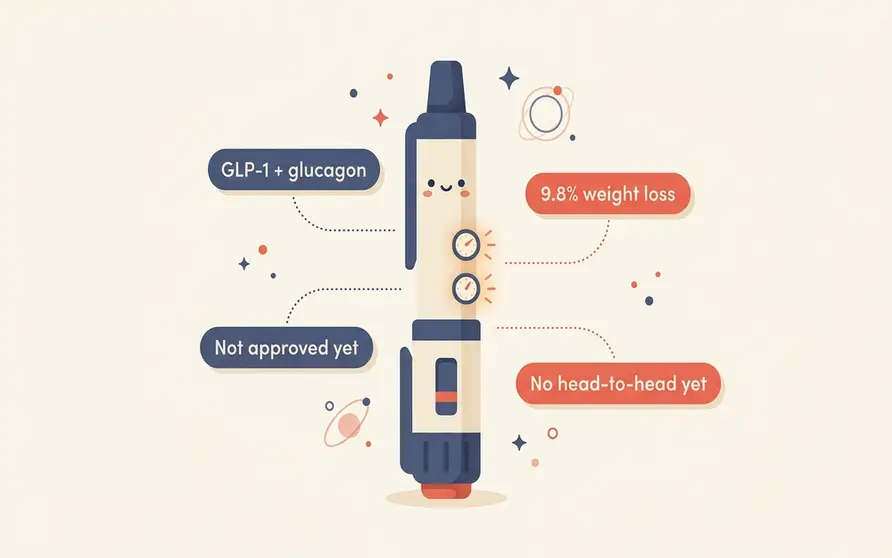
A new drug name has started showing up in weight-loss headlines: survodutide. It arrives with a familiar promise and an unfamiliar design. On October 1, 2026, the first phase 3 results for survodutide were published in The New England Journal of Medicine, which is the moment a drug moves from trade press into the questions real patients type into a search bar.1 This article explains what survodutide is, what that trial actually found, and why the question everyone asks - is it better than Ozempic? - cannot honestly be answered yet.
What is survodutide?
Survodutide (laboratory name BI 456906) is an investigational once-weekly injection being developed by Boehringer Ingelheim and Zealand Pharma. "Investigational" means survodutide is still being tested in clinical trials and is not approved for sale by any regulator.2 It is injected under the skin once a week, the same format as Ozempic and Mounjaro.
What sets survodutide apart is the hormones it imitates. Survodutide is a dual agonist, meaning it switches on two receptors at the same time: the GLP-1 receptor, which curbs appetite, and the glucagon receptor, which the newer research suggests raises energy expenditure and helps clear fat from the liver.2 That glucagon arm is the part Ozempic does not have.
How is survodutide different from Ozempic?
Ozempic and Wegovy both contain semaglutide, a single GLP-1 agonist. Mounjaro and Zepbound contain tirzepatide, which adds a second gut hormone called GIP. Survodutide takes a different second lever again, glucagon, and that choice is the whole reason the drug exists.
| Drug (brand) | Receptors it targets | Status |
|---|---|---|
| Semaglutide (Ozempic, Wegovy) | GLP-1 | Approved |
| Tirzepatide (Mounjaro, Zepbound) | GLP-1 + GIP | Approved |
| Survodutide (BI 456906) | GLP-1 + glucagon | Investigational (phase 3) |
Sources: SYNCHRONIZE-2, New England Journal of Medicine, 2026;1 Sergi, Contemporary Clinical Trials, 2026.2
Survodutide is one of several multi-hormone drugs now moving through late-stage trials. If you want the wider map of what is coming, the Academy tracks it in how many GLP-1 drugs there are now. Retatrutide, covered in what we know about retatrutide and TRIUMPH-1, adds glucagon as well, but on top of both GLP-1 and GIP, so it is a triple agonist rather than a dual one.
What did the trial actually show?
SYNCHRONIZE-2 was a multinational, double-blind phase 3 trial in 752 adults who had both type 2 diabetes and a body mass index of 27 or higher.1 Participants were split evenly into three groups: survodutide 3.6 mg, survodutide 6.0 mg, or a placebo injection, each given once a week for 76 weeks.
At week 76, average body weight fell by 8.2% on the 3.6 mg dose and 9.8% on the 6.0 mg dose, compared with 3.9% on placebo.1 A weight loss of at least 5% was reached by 57.6% of the 3.6 mg group and 64.5% of the 6.0 mg group, versus 35.1% on placebo. Blood sugar improved too: average HbA1c, a three-month measure of glucose control, dropped by about 0.8 to 0.9 percentage points from a 7.4% baseline, against 0.2 on placebo.
The cost of that benefit was stomach upset. Gastrointestinal side effects, mostly nausea, vomiting and diarrhoea and generally mild to moderate, affected 72.8% of the 3.6 mg group and 77.7% of the 6.0 mg group, compared with 38.6% on placebo.1 Those symptoms were linked to the dose and tended to ease over time, but they are the recurring price of the glucagon arm.
"The glucagon lever is what makes survodutide interesting, and it is also what makes it hard on the stomach."
Why you cannot call it better yet
The honest answer to "is survodutide better than Ozempic" is that nobody knows, for three concrete reasons. First, SYNCHRONIZE-2 compared survodutide against a placebo, not against semaglutide or tirzepatide.1 A drug can only be called better than another drug when the two are tested head-to-head in the same trial, and that trial has not been run.
Second, SYNCHRONIZE-2 studied people with type 2 diabetes. Weight loss in diabetes trials is consistently lower than in obesity trials of the same drug, so the 9.8% figure cannot be lined up against the 15% to 23% headlines from obesity-only trials of other drugs. Comparing across different trial populations is one of the easiest ways to be misled, a trap the Academy also flags in whether CagriSema is better than Ozempic.
Third, the headline number depends on how it is measured. The published 9.8% is the "treatment-regimen" result, which counts everyone in the group regardless of whether they stayed on the drug. Press coverage has quoted a higher figure of around 13% for the same trial; that version measures the effect only in people who took survodutide as directed. Both numbers are real, but they answer slightly different questions, and the lower, more conservative one is the fairer headline.
What about the obesity results?
A separate trial, SYNCHRONIZE-1, tested survodutide in 726 people who had obesity but not diabetes, and it has now finished.3 That is the trial expected to produce the big weight-loss number, and a figure near 16.6% has circulated in conference coverage. As of October 2026, however, SYNCHRONIZE-1 has no results posted on the clinical-trials registry and no peer-reviewed paper.3 Until those results are published and can be checked, the obesity figure should be treated as a preview, not an established fact.
Is survodutide approved or available?
No. Survodutide is investigational, so it cannot be prescribed or bought, and there is no approved dose or price.2 Beyond weight and diabetes, the glucagon arm is also why survodutide is being studied for metabolic liver disease, where early signals on liver fat drew interest. The same arm, though, is tied to the high rate of nausea, so the mechanism cuts both ways.
In one sentence: survodutide is a promising investigational dual agonist that produced solid, honestly reported results in one diabetes trial, but it is not approved, its obesity data are not yet published, and no study has ever put it head-to-head with Ozempic.
Frequently asked
What is survodutide?+
Is survodutide better than Ozempic?+
How much weight did people lose on survodutide?+
References
- Wharton S, le Roux CW, Startseva E, et al; SYNCHRONIZE-2 Investigators. Survodutide once weekly in adults with obesity and type 2 diabetes. New England Journal of Medicine. Published online October 1, 2026. DOI: 10.1056/NEJMoa2607219. PMID: 42820639. ClinicalTrials.gov: NCT06066528. Funded by Boehringer Ingelheim; several authors are company employees.
- Sergi CM. Survodutide for the treatment of obesity: mechanistic rationale, clinical evidence, and remaining uncertainties. Contemporary Clinical Trials. 2026;170:108493. DOI: 10.1016/j.cct.2026.108493. PMID: 42822760.
- ClinicalTrials.gov. A study to test whether survodutide (BI 456906) helps people living with overweight or obesity (SYNCHRONIZE-1). NCT06066515. Phase 3; 726 participants; overall status completed; no results posted as of October 2026. US National Library of Medicine.
Evidence current as of October 19, 2026. Survodutide is an investigational drug and is not approved for use. This article is educational and not medical advice. Always consult your clinician before changing medication, diet or exercise.
Translating new metabolic and obesity research into plain English for people living on GLP-1 therapy. Every claim is traced to its source.