Is there a once-a-month GLP-1 injection yet?
No. As of 2026, no once-a-month GLP-1 injection is approved or sold anywhere. The furthest-along candidate, berobenatide, made by Pfizer, is still in phase 3 testing for monthly dosing, with results not expected until 2028. The weight-loss numbers in the news so far come from once-weekly dosing, not monthly.
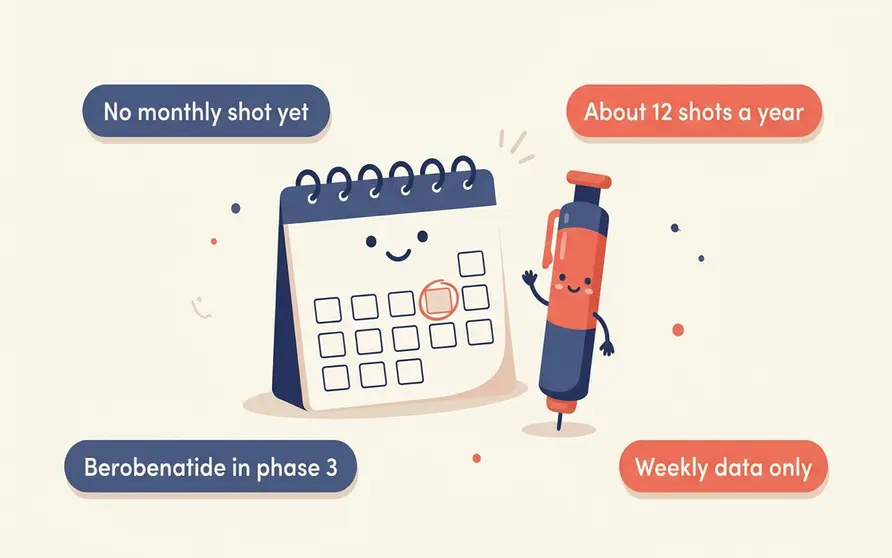
Weekly injections are the norm for GLP-1 weight-loss drugs. Ozempic, Wegovy, Mounjaro and Zepbound are all taken once a week, which adds up to about 52 injections a year. A once-a-month shot would cut that to roughly 12, so the idea is easy to understand and has started to show up in headlines and search queries. So is a monthly GLP-1 injection actually available yet?
Is there a monthly GLP-1 shot yet?
No. As of 2026, no once-a-month GLP-1 injection is approved or sold in any country. Every GLP-1 medicine on the market, including the newer oral pills, is dosed weekly or more often. One investigational drug, berobenatide, is being developed specifically for monthly injection, but it is still in clinical trials and cannot be prescribed. Anyone offering a monthly shot today is describing a trial drug, not an approved medicine.
What is berobenatide?
Berobenatide is an investigational, ultra-long-acting GLP-1 receptor agonist designed to be injected once a month. It carries two names in the research: MET-097i, the code used by Metsera, the biotechnology company that first developed it, and PF-08653944, the code used by Pfizer, which completed its acquisition of Metsera in November 2025.5 Pfizer describes the compound as a weekly and monthly injectable GLP-1 agonist that is moving into phase 3 development.5
The design goal is to make the drug stay active in the body long enough to space injections a month apart instead of a week apart. That is a pharmacology problem, not a settled result: whether monthly dosing holds up on effectiveness and side effects is exactly what the current trials are built to find out.
What has berobenatide actually shown?
Less than the headlines suggest, and only for weekly dosing. The only trial results posted to the public registry come from a completed phase 2b study (NCT06712836) that tested the drug once a week, not once a month. In that study, the highest weekly dose produced a 12.45% drop in body weight at 28 weeks, compared with a 1.67% gain on placebo.1
That weekly result is where the "12%" and "14%" figures circulating in the news come from. No results from monthly dosing have been published or posted anywhere yet, so how well berobenatide works on a once-a-month schedule remains an open question the phase 3 trials are designed to answer.
Which trials are testing monthly dosing?
Pfizer has launched a broad phase 3 program to test berobenatide given once a month. These trials are recruiting now, and their main results are not expected until 2028.2
| Trial (registry ID) | What it tests | People | Main results |
|---|---|---|---|
| NCT07595549 | Monthly shot vs placebo | 954 | 2028 |
| NCT07845500 | Switch from weekly drug to monthly | 660 | 2028 |
| VESPER-OSA 1 (NCT07823608) | Monthly shot for sleep apnoea | 258 | 2028 |
Source: ClinicalTrials.gov, verified October 2026. "People" is the planned enrollment; "Main results" is the estimated primary-completion year.234
One of these trials is worth singling out. NCT07845500 is testing whether people already losing weight on weekly semaglutide or tirzepatide can switch to monthly berobenatide and hold that weight off.3 That switch-and-maintain question is the practical one for most readers: not "does a brand-new drug work," but "could I trade my weekly injection for a monthly one without losing ground."
"No monthly GLP-1 injection is approved anywhere in 2026. One candidate is in phase 3, and the numbers in the news so far come from weekly dosing."
Why would a monthly shot matter?
The main appeal is convenience, and with it, staying on treatment. Fewer injections can mean fewer missed doses, less injection fatigue, and an easier routine, all of which tend to help people keep taking a long-term medicine. For a drug that only works while you take it, better adherence is a genuine advantage, not a cosmetic one.
There is a trade-off, though, and the trials are built to study it. A medicine designed to stay active for a month cannot simply be stopped week to week. If side effects such as nausea appear, a monthly depot keeps working until it clears on its own, rather than being paused at the next weekly dose. Whether that changes the real-world side-effect experience is one of the questions phase 3 still has to answer.
When could a monthly GLP-1 arrive?
Not soon. The monthly phase 3 trials are not expected to reach their main results until 2028, and a drug normally needs those results reviewed and then approved by regulators before it reaches pharmacies.2 That pushes any realistic availability for a monthly GLP-1 toward the end of the decade at the earliest, and only if the trials succeed. Promising timelines shorter than that are guesses, not facts.
Is berobenatide the only monthly option?
No. Berobenatide is the furthest along, but it is not the only drug aiming for less-frequent dosing. Amgen's MariTide is also designed for monthly or even less frequent injection, though it is being studied with a different emphasis, including heart and metabolic outcomes.Our MariTide explainer covers that one. The two are separate compounds, so the monthly race has more than one entrant.
In one sentence: no once-a-month GLP-1 injection is approved yet, one candidate (berobenatide) is in phase 3 testing for monthly dosing with results due in 2028, and the weight-loss numbers so far come from weekly, not monthly, dosing.
Frequently asked
Is there a monthly GLP-1 injection available now?+
What is berobenatide?+
How much weight does berobenatide cause people to lose?+
References
- ClinicalTrials.gov. A phase 2b study to examine the safety and efficacy of once-weekly MET097 (berobenatide / PF-08653944) in adults with obesity or overweight. Sponsor: Pfizer (originally Metsera). Study completed; posted results, percent change from baseline in body weight at week 28, Part A. NCT06712836. Registry results accessed October 20, 2026.
- ClinicalTrials.gov. A study to learn about the study medicine called berobenatide (PF-08653944) in people with overweight or obesity. Phase 3, recruiting, planned enrollment 954, estimated primary completion May 2028. NCT07595549. Accessed October 20, 2026.
- ClinicalTrials.gov. A study to learn about switching to a monthly study medicine called berobenatide (PF-08653944) to help keep weight off in people with overweight or obesity. Phase 3, recruiting, planned enrollment 660, estimated primary completion February 2028. NCT07845500. Accessed October 20, 2026.
- ClinicalTrials.gov. A study to learn about the monthly dosing study medicine called berobenatide in adults with breathing problems during sleep and overweight or obesity who use a breathing machine (PAP) - VESPER-OSA 1. Phase 3, recruiting, planned enrollment 258, estimated primary completion April 2028. NCT07823608. Accessed October 20, 2026.
- Pfizer. Pfizer completes acquisition of Metsera. Press release, November 12, 2025. pfizer.com. Accessed October 20, 2026.
Evidence current as of October 20, 2026. Berobenatide is an investigational drug that is not approved or available. This article is educational and not medical advice. Always consult your clinician before changing medication.
Translating new metabolic and obesity research into plain English for people living on GLP-1 therapy. Every claim is traced to its source.