Did my birth control make me need Ozempic?
No study has shown that birth control causes the weight gain that leads to Ozempic. A 2026 Danish study of 22,694 women found that contraception users were 1.4 to 2.1 times more likely to later start semaglutide, but this is an association, not proof of cause - and adjusting for body weight shrank the link.
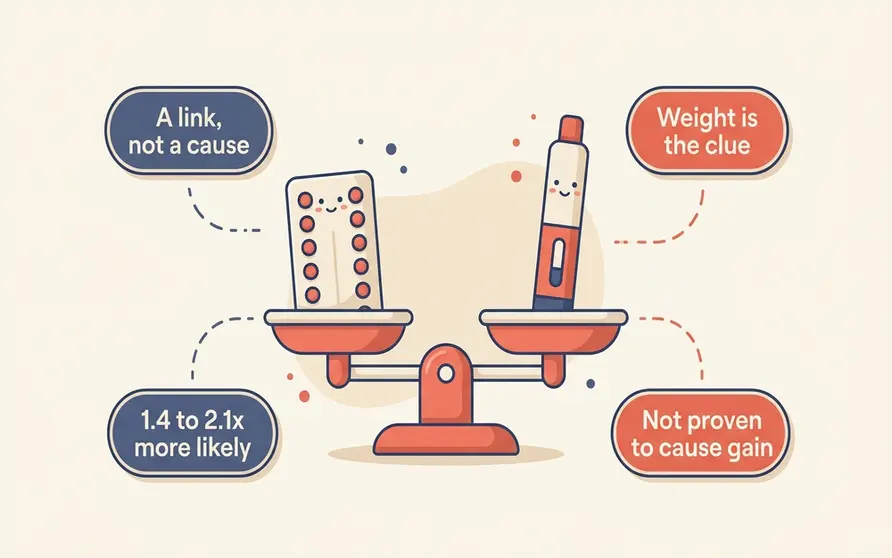
If you spent years on the pill and then found yourself prescribed Ozempic, it is natural to wonder whether the two are connected. A 2026 Danish study gave that worry a number, and the number is easy to misread. Hormonal contraception use was linked to a higher chance of later starting semaglutide, the active ingredient in Ozempic and Wegovy.1 The link is real. What it means is a different question, and the honest answer is more reassuring than the headline.
What did the study find?
Researchers used Danish national health registers to compare 22,694 women who started semaglutide, with no prior diabetes medication, against 229,640 women of the same birth years who did not.1 Every pattern of hormonal contraception use was associated with a higher chance of later starting semaglutide. The study was published in JAMA Network Open in July 2026.
The size of the link depended on which methods a woman had used. Women who had used a single type of contraceptive were about 1.4 to 1.6 times more likely to start semaglutide; women who had used several types over the years reached roughly 2.1 times. The exact figures are below.
| Contraception pattern | Odds of later starting semaglutide |
|---|---|
| Combined oral pill only | 1.42x (95% CI 1.34-1.51) |
| Progestin-only IUD only | 1.63x (95% CI 1.46-1.82) |
| Combined pill, then progestin pill | 1.64x (95% CI 1.47-1.82) |
| Most mixed patterns | 2.11x (95% CI 1.97-2.25) |
Source: Bager et al., JAMA Network Open, July 2026. Figures are adjusted hazard ratios; a value of 1.42 means 42% higher odds.1
Does this prove the pill caused it?
No, and the study itself does not claim it does. This was a nested case-control study, a design that compares people who had an outcome against people who did not and looks backward at what they were exposed to. That design can reveal that two things travel together. It cannot show that one caused the other.
The authors framed their result neutrally, writing that it highlights "a need to examine factors associated with weight management in females," not that contraception causes weight gain or a need for semaglutide.1 A hazard ratio of 1.4 to 2.1 for starting semaglutide after contraception is a correlation, and a correlation is a question, not an answer.
"A statistical link is not a cause. The study cannot say the pill made anyone need Ozempic."
Is weight the real explanation?
The strongest clue sits inside the study. When the researchers adjusted for body mass index, the association shrank but did not disappear.1 That tells you weight is doing much of the work in the link. Women carrying more weight are both more likely to be prescribed certain contraceptives and more likely to later be offered a weight-loss drug, so weight sits on both sides of the relationship.
There is a second, quieter explanation the study flags: women who use prescription contraception are already in regular contact with the health system. Regular clinical contact raises the chance of being offered a newer medication like semaglutide in the first place. Epidemiologists call this confounding by health-care-seeking behaviour, and it can manufacture a link that looks like cause without any biological pathway between the two.
A register study also counts filled prescriptions, not lived experience. It does not know a woman's real weight history, why each contraceptive was chosen, or whether she actually took every dose. Those gaps all push in the same direction: toward an association that cannot be read as the pill making anyone need Ozempic.
Does the pill cause weight gain?
This is the fear underneath the headline, and the controlled evidence is reassuring. A Cochrane review of 49 randomised trials of combined hormonal contraceptives found no evidence supporting a causal link between the pill and weight change, and concluded that no large effect was evident.2 Many women and clinicians believe a link exists; the trial data does not confirm one.
The picture is similar for progestin-only methods. A separate Cochrane review of 22 studies and 11,450 women found that comparison groups did not differ significantly in weight change for progestin-only pills, implants, injections or the hormonal IUD.3 Both reviews note that weight naturally drifts upward over the years regardless of contraception, which is exactly why a before-and-after impression can feel like proof when it is not.
Who funded the research?
Transparency matters on a question like this. Two of the Danish study's authors disclosed ties to Novo Nordisk, the company that makes semaglutide: one reported speakers' honoraria and the other reported grant support from the Novo Nordisk Foundation, both outside the submitted work.1 These disclosures do not invalidate a large, well-conducted register study, but they belong in the open when a finding touches a company's own product.
One more point keeps the two contraception questions apart. Whether being on contraception is associated with later needing semaglutide is a different question from whether a GLP-1 drug can weaken the pill, which is a known interaction for tirzepatide. The Academy covers that separate interaction and fertility question in does Ozempic make you more fertile; this article is only about the association, not the interaction.
In one sentence: A 2026 Danish study found women on hormonal contraception were 1.4 to 2.1 times more likely to later start semaglutide, but that is a heavily weight-confounded association, not evidence that birth control made anyone need Ozempic.
Frequently asked
Does hormonal birth control cause weight gain?+
Did the 2026 Danish study prove the pill leads to Ozempic?+
Should I stop my birth control to avoid needing Ozempic?+
References
- Bager MD, Wood-Kurland HK, Sorensen KK, Kragholm KH, Andersen MP, Torp-Pedersen C, Wurtz Yazdanfard PD. Hormonal contraception and initiation of semaglutide therapy. JAMA Network Open. 2026 Jul 1;9(7):e2624382. DOI: 10.1001/jamanetworkopen.2026.24382. PMID: 42485041. Note: authors Kragholm and Torp-Pedersen disclosed ties to Novo Nordisk, the maker of semaglutide, outside the submitted work.
- Gallo MF, Lopez LM, Grimes DA, Carayon F, Schulz KF, Helmerhorst FM. Combination contraceptives: effects on weight. Cochrane Database of Systematic Reviews. 2014 Jan 29;2014(1):CD003987. DOI: 10.1002/14651858.CD003987.pub5. PMID: 24477630.
- Lopez LM, Ramesh S, Chen M, Edelman A, Otterness C, Trussell J, Helmerhorst FM. Progestin-only contraceptives: effects on weight. Cochrane Database of Systematic Reviews. 2016 Aug 28;2016(8):CD008815. DOI: 10.1002/14651858.CD008815.pub4. PMID: 27567593.
Evidence current as of October 14, 2026. This article is educational and not medical advice. Do not start, stop or change any contraceptive or GLP-1 medication based on it; always consult your own clinician.
Translating new metabolic and obesity research into plain English for people living on GLP-1 therapy. Every claim is traced to its source.